Clearance
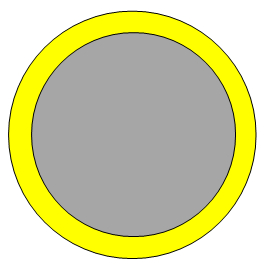
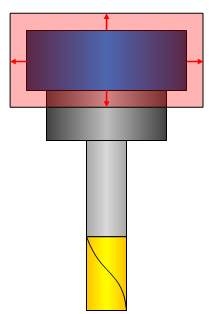
The tool clearance will apply a cylindrical or conical offset to the holder, arbor and shaft.
Notes:
- The arbor is the extension of the tool and is located between tool and holder.
- Lollipop and Slot End Mills do not have tool shaft, the cylindrical connection between tool and holder is here considered also as arbor.
If the surfaces to be considered have a stock to leave value, then clearance and stock to leave values are added to keep the arbor away from part by given distance. E.g. if arbor clearance is 0.2 and the user applied a stock to leave of 0.5 on surfaces, then the arbor is not allowed to come closer than 0.2 + 0.5 = 0.7 to the part.
Cylindrical clearance
Shaft
This is the clearance onto the shaft. Only the diameter will be expanded.
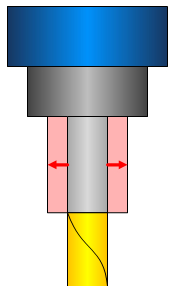
Arbor
This is the clearance onto the arbor. The clearance is applied to the diameter as well as to the height.
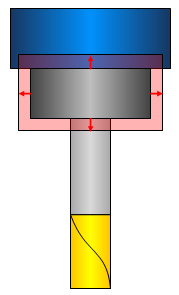
Holder
This is the clearance onto the holder. The clearance is applied to the diameter as well as to the height.
Conical clearance
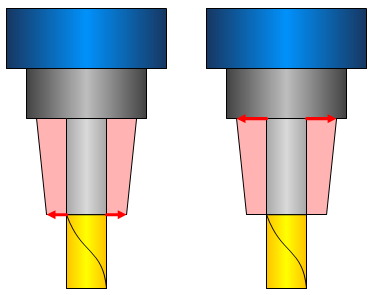
Shaft
The user must input an upper and lower clearance value. In this way it is possible to define a conical clearance.
This is the clearance onto the shaft.
The upper clearance always has to be bigger than the lower clearance.
Arbor
This is the clearance onto the arbor. The clearance is applied to the diameter as well as to the height.
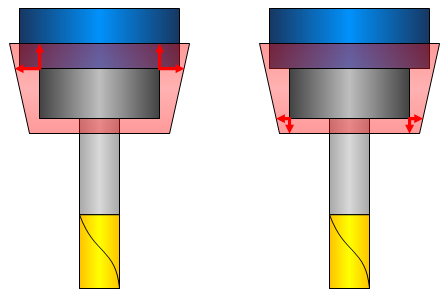
Holder
This is the clearance onto the holder. The clearance is applied to the diameter as well as to the height.
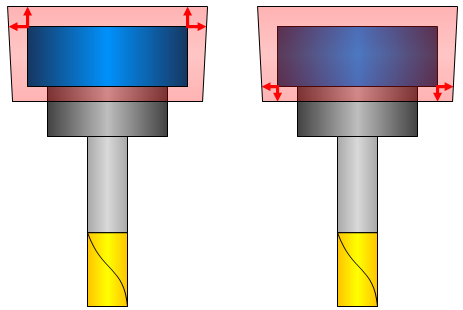
Angular clearance
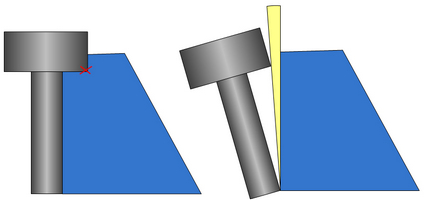
The conical clearance will be applied between tool and collision. It will be spanned between the contact point of the tool and the drive surface and the collision point. It can be understood as a protection cone.